Tuesday, 1 December 2015

Musings on Memorials

Over my 8 months or so of tour guiding in Berlin, I've become increasingly aware of why it is that people are so fascinated with Berlin: Berlin has seen it all. It is perhaps a perfect illustration of the heights of Western Civilisation (at least post enlightenment) juxtaposed to the very depths of horror that human beings can create. For this reason, many historians have pointed out that Berlin is a city built on perhaps the most contradictory history of any city in the world. 

By far the most intriguing aspect of the history though, for the 11 million or so visitors that come every year, is undoubtedly the period between 1933 and 1945. The rise of the Nazis to power, their attempt to create the Third Reich of Germany that was meant to last 1,000 years, and the subsequent annihilation of the pre-war German nation, and the attempted annihilation of an entire people, I am of course talking of European Jews during the holocaust. 

Why then are people so fascinated with Nazism? Is it because it represents the worst of humanity? Is it because we are still rather dazed and confused in its wake, trying to understand how it was all possible? Or is it because it represents a warning in history - something we need to remember so that it can never happen again? The easiest way for me to understand the reason why people are so fascinated by this period, and also why we choose to remember it in such minute detail, is to look at the memorials scattered around Berlin that tell this grim story.

The Memorial to the Murdered Jews of Europe

The Memorial to the Murdered Jews of Europe is a huge memorial that takes up a whole city block in the centre of Berlin's government and commercial district. It is just a few hundred yards from the Reichstag in one direction, and Potsdamer Platz in the other - unmissable in length and breadth. It was built in 2005 to remember the estimated 6 million European Jews that were murdered by the Nazis. In total, though estimates vary massively, it is thought that the Nazis murdered around 11 million people due to their race, physical or mental state of health, sexuality, ethnicity (Sinti & Roma made up a large majority of these people), political beliefs or simply because they were deemed (mostly summarily) to be a danger to the advancing German armies on the Ostfront. As the title of the memorial indicates though, we are being asked there to think specifically about the Jews who were persecuted the most ferociously by the Nazis from 1933 onwards.  

The memorial is comprised of 2,711 concrete blocks or stelai, each at a unique height, arranged in straight lines on an uneven surface. The blocks start off quite often sunken into the pavement in the outer sections and steadily climb to dizzying heights until a climactic level that towers over the humans scurrying below. The horizontal and vertical straight lines force visitors to move forward at all times, and their spacing also prevents walking in groups, thus isolating people soon after entering the memorial. The overwhelming feeling one has when entering is how on earth to get out. 

Memorial to the Murdered Jews of Europe
The meaning of this memorial is unclear - it is undefined and abstract. This was a purposeful decision taken by the architect Peter Eisenmann, so that each one of  the visitors would find their own meaning within it, reflected on the dark, dull, flat concrete shafts. The only thing that he did tell us is that he wanted to create a "seeminly ordered human system that has descended into chaos and lunacy". The architect is attempting to tell us to not try to use reason and logic to explain the insane and illogical - instead, we must use our emotions to guide our response to this most heinous of crimes. We are being asked to walk in the shoes of those who, because of a hate-filled ideology, were forced to walk paths that led them to gas chambers. 

Long lines created by the horizontal and vertical order of the concrete blocks.
I've visited this site many times and brought countless groups here, yet I am still getting different answers to the question of what it represents: 
  • For some it is a graveyard - the cement blocks being the blank and anonymous tomb stones.
  • For others each cement block represents a unique individual caught up in the crimes of war.
  • Some say that the cold concrete reminds them of the cold, calculated and systematic killing done by the Nazis.
  • Others point out that the uneven floor signifies the chaos of the lives of Jews attempting to live under Nazi dictatorship.
  • Many have also said that the gradual growth of the blocks represents the movement towards totalitarianism and oppression.
All of these are right. All of them are valid. There are many many other interpretations I have heard over the months; personally, my first reaction was that it was a maze but rather disturbing as there was nowhere to hide. What seems to be universal though, is that it makes people think, it makes people engage and in a small way, it makes them walk in the shoes of the Jews who were murdered so grotesquely because of an ideology of hate. The memorial, standing concretely in the centre of this city seems to be screaming at the top of its lungs: come, walk, see, this is what hate brings, we can't let it happen again. Its immobility indicative of the permanence of its message: a desperate plea from a tragic past. 

Neue Wache - Memorial for victims of War and Tyranny

In a neoclassical styled guard house on the Unter den Linden, right in the centre of Berlin, there is a memorial dedicated to Den Opfern von Krieg und Gewaltherrschaft (victims of war and tyranny). In the middle of an empty, expansive, square room there is a smallish figure of a hunched woman cradling her dead son. His head lolls back into her body, without the strength of life to keep it upright; his left foot is mangled at an awkward angle towards his mothers legs; he is naked, weak, feeble, helpless, the body of a broken young man. She sits head bowed towards him with one hand up to her face as if covering a deep sob, her other hand attempts to hold that of her limp son's fingers, the two hands caught by the viewer touching their last touch.


The sculpture by Kathé Kollwitz perfectly sums up the devastation of war, sitting all alone in this large room underneath an open circular hole in the roof. She is alone, unprotected and inconsolable in her intense grief. Kathé Kollwitz sculpted this masterpiece in 1932, 18 years after the death of her youngest son Peter at the Western Front during the 1st World War. He had died 10 days after reaching the front. She was never able to get over the intense grief of losing him, and having failed to protect him from the brutalities of war. It has been described as a woman's response to a man's war and has become a symbol of the futility and pitiless of war. In a recent publication the director of the British Museum described the sculpture as representing our duty towards each other:
"Our duty to nurture and defend each other is analogous to a mother's protective love for her child and in each case failure means death." 
Neil MacGregor, Director of British Museum
Denkmal den Opfern von Krieg und Gewaltherrschaft
In the early 1990s after the unification of Germany, it was time to come to a unified decision on how the second world war would be viewed. This is the product of that discussion. There is no honour in this sculpture, there is no glory, we see instead the broken body of a soldier cradled by his distraught mother. It was one of the most moving memorials I have ever seen and one that I immediately connected with. No other memorial has ever proclaimed the futility and tragedy of war for me in such a way. The mother becomes a symbol of the state, her son its citizen. The contemporary chancellor, Helmut Kohl said as much at the time by commenting that:  
"The principles that underline this creative work of this great artist are indissolubly linked with our concept of the state...which is founded on the same principles."
Helmut Kohl, 1993
Coming from a very different historical background in Britain, it is difficult for me to imagine a national monument embracing such an unheroic symbolism related to war. We are not comfortable seeing weak and feeble soldiers portrayed as lambs to the slaughter, and instead prefer to postulate on the heroism and glory of their noble sacrifice. I guess it's because we can, or at least because we want to. There is no memorial, for instance, to the many millions murdered under colonialism. We don't even teach British colonialism in schools. We chose to be ignorant on this stain on our national pride. We chose not to remember the darkness, because we can. Britain and its colonial armies helped Russia defeat the most evil government in history, and thus our evil governments of times gone by can pale into insignificance and our soldiers can be hailed as glory ridden sons of the nation. 

But here in Germany, that is simply not possible. When you've had a history as dark as the 20th Century in Germany, there is no glory to project. Instead, there is only reflection, deep deep reflection and a crying, screaming wish that it should never happen again. So I implore you all, the next time you come to Berlin and look at its many memorials, to ask yourselves: why do we remember these terrible events? Here the answer is clear, it is to ensure that ignorance and hatred will never again lead to the slaughter of millions. We would all do well to remember our own history in such a way.

Monday, 9 November 2015

Worker's Paradise Lost: Alexanderplatz

I am writing this week's blog post, fittingly, inside a café called Commune, branded with the yellow soviet star across its door. Seeing that my last post acted as a tribute to modern, post unification architecture, I thought it fitting, this time, to discuss one area that I feel has been rather neglected since "Die Wende" 26 years ago (1989): Alexanderplatz.

The old Haus der Statistik (Department of Statistics) of the State Security (Stasi) sits, completely empty, next to the bustling commercial hub of Alexanderplatz. This fact is made more surprising when we consider that the building is the size of a city block. It looks as though it has been abandoned for decades. All 8 floors bear the hallmarks of a building ravaged by age, general wear and tear and of course, vandalism. All the glass from the windows more than two floors up has been meticulously removed with a precision that suggests this was more an act of municipal care-taking than vandalism. The walls of the building have flecked paint that has fallen off in clumps to create a facade not unlike the liver diseased skin of the old. Graffiti paints images of societal frustration over the forgotten entrance ways, and wooden boards, used to cover possible entry points, have been turned into billboards for concerts and clubs.

Haus der Statistik, Otto Braun Straße
On this wintry November day, birds fly up the swirling air currents to the top of the building and peer in through the empty windows into spaces long vacated by their human tenants. I need not wonder what they see, I have Youtube for that. Others, more intrepid than me, have been as curious about this building as I, and gone as far as to join our winged friends in the empty hallways and desolate offices of the old Haus der Statistik. Their videos and pictures reveal that nothing is left inside those drafty rooms; no mountains of paper containing information on every purchase made, or school records for every East German child, every car bought, book read, test passed, job quit, baby born, house sold, play seen, movie produced, article written and marriage registered. The objective of the Stasi was simple: to know everything. This would have been the building where "everything" was calculated and quantified.

The building stands metres from Alexanderplatz showing the centrality of state security to the East German government. On one side of the building stretches the mighty Karl Marx Straße named thus in 1953 after the often accredited prophet of Communism; Otto Braun Straße on the other side. The heart of old East Berlin was clearly a canvass for heroes of the now lost German Democratic Republic/East Germany (henceforth GDR). The GDR existed as a separate country next to the Federal Republic of Germany (FDR) for 40 years. Its capital was East Berlin. Today traces of the regime lie in abandoned architecture, Trabi car city tours, crusty old GDR politicians that have made their way into today's Bundestag and of course the remnants of the Berlin Wall

Fernsehturm, TV Tower finished in 1969.
However, one not so abandoned piece of GDR architecture that stands at the centre of Alexanderplatz has become perhaps the most recognisable landmark of Berlin: the TV Tower. The pillar reaching skywards is as phallic in its appearance as its original function. It stands at 368 metres, towering over the rest of Berlin and Europe. It is the tallest structure in Germany and the second tallest in the European Union (the first being in Latvia - Riga Tower). Finished in 1969, the TV Tower was the crowning winner of the architecturally ominous time of "competitive building" in Berlin. This policy directive by both sides led to architectural monstrosities of 1960s proportion to prove whose was bigger, taller, longer, could piss the furthest (oh no, buildings can't piss - my bad). However, Walter Ulbricht's GDR brought this to an end, thankfully, in 1969 with the TV Tower. Finally, Walter could be assured that his was indeed taller than the West's - arguably the most important policy objective of any cold war politician. 

That political rivalry that had turned into architectural competition came to clamouring halt though in 1989. On the 9th November the wall fell after perhaps the most famous blunder in press conference history made by the now recently deceased Gunter Schabowski. Within a year Germany was reunified and the GDR was gone.

TV Tower from the roof of the Haus der Statistik of the GDR, 1969, by Eva Brüggman
Stephan Heym, the East German writer, remarked in 1990 that "the GDR will be nothing but a footnote in history", a damning sentiment expressed by an ardent critic (though a committed socialist) of the regime he had lived in since 1949. 26 years after the fall of the Berlin Wall, looking at buildings like the forgotten Haus der Statistik, it seems as though he had a point. On the other hand, doesn't everything at one point fade into a footnote? 

It makes me wonder about the reasons for remembering at all. Is it living memory that keeps history alive? Or perhaps it's architecture and culture that keeps the past fresh in our minds? Maybe it's trauma that makes us want to remember? Or the need for contemporary regimes to paint a monster in the past to justify the suffering of their own people in the present? What is it about certain times, cultures, institutions and structural changes that intrigues us about history? How and why do we remember at all?

Maybe we hope that remembering past traumas will help us to mitigate them in the future. Or maybe we remember past greatnesses (British colonialists built railways in India didn't you know) in order to feel the slightest bit relevant to the present. It seems to me that there is always a reason for remembering some things and forgetting other things. Complicated narratives of people having diverse experiences of the same period can seem too difficult to integrate into historical study that often craves simplicity. Remembering the GDR is no different. 

Haus der Statistik in the background taken from Alexanderplatz, 1971, Hubert Link.
Films like "The Lives of Others" have constrained our popular understanding of the GDR to the ugliest part of its rather mundane footwear. However, other films, like "Goodbye Lenin" and "Sonnenallee" paint the other extreme of a naive culture that perhaps did have a better concept of solidarity, community and social good than we have today. The truth, or millions of simultaneous truths that exist side by side in history, is often somewhere in the midst of the extremes: the GDR had a perverse surveillance system; the GDR had very little consumer choice; the SED party of the GDR was convinced that anyone wanting to be different from the socialist stereotype was a threat to society that needed to be expunged. The GDR forced at least 400,000 people to flee its borders, often in perilous ways, after they put up a wall in 1961 to keep their citizens inside; the GDR was a totalitarian regime without real democratic choice.

But on the other hand, the GDR had universal healthcare, education and social security. The GDR had housing for all its citizens. The GDR provided free childcare so that women could aspire alongside their male counterparts, rather than being biologically hindered in their professional lives. The GDR had a sense of social obligation that brought people companionship that today is often lacking. The GDR had a central sentiment that no one, no matter what socio-economic background they came from, was better than anyone else. The GDR had very little crime (no one had all that much to steal anyway). All these things existed next to each other, meaning that when we look back now - 26 years to the day after the Berlin Wall fell - we see a jumbled mess of good and bad aspects of a mostly content but imprisoned citizenry. 

It makes me wonder how people in the future will view our society. Our global society. A society that has an incredibly intrusive mass surveillance system; a society with camps for those that don't fit in (just go to Calais to see what I mean); a society incapable of making much needed global decisions because of outdated concepts of nationalistic need; and finally, a society with a global rich (in which I include myself) that tirelessly exploits those unable to defend themselves against its ravages. How will they look back on our society? How will we be judged? Will abandoned buildings in the centre of old financial districts paint poignant pictures of a broken past? Perhaps. 

One thing that GDR history has taught me for certain though, is that freedom, perceived or real, is fundamental to a human being's sense of self. Once you have placed the shackles on people for long enough, they will fight back. In the GDR they fought back peacefully and on the 9th November 1989, without bloodshed, the citizens of East Germany were finally able to call themselves free.

Alexanderplatz protest, 4th November 1989. 500,000 East Germans gathered on Alexanderplatz to protest for freedom of press, political freedom and freedom of movement. Foto. Peter Zimmerman, 1989
For me, Alexanderplatz is the embodiment of these contradictory historical interpretations, which come together to produce a confused though more enlightened vision of a country's past. The abandoned block buildings stand next to modern arcades, restaurants, cinemas and the nerve centre of transport in Berlin, the Alexanderplatz S & U Bahn Station. Decay standing next to progress; just as the sometimes difficult past stands ever next to hope for a better future.

Saturday, 24 October 2015

Potsdamer Platz

In the centre of a bustling intersection at the end of Leipziger Straße, in the heart of Berlin's commercial district, stands a traffic light. This traffic light is dark green and 20 ft in height, it is five sided and clocked. Lights flash in regular intervals from red to green to red to green not unlike the continuous ticking of the five clocks in unison. In the centre of the street stands a traffic light. In any other city this would be a rather mundane observation worthy of mention in only the most obscure and specialised of blogs, but this is not any city and likewise this is no normal traffic light. 

In 1924 the exact same model was the first electronic traffic light in Europe, installed here at what was the busiest intersection in the four million strong metropolis of 1920s Berlin. The traffic light was a symbol of a city surging forward into modernity, restless and eager to consume the gadgets of the future. 
Potsdamer Platz in the 1920s at the centre of the busy metropolis life of Berlin

The traffic light stands today as testament to its prized position in days gone by.
Potsdamer Platz of the 1920s was a testament to Berlin's growth, exuberance, modernity and unbridled capitalism that lay at the beating heart of the industrial powerhouse. Since 1900 the city had doubled its population and was now the third largest city in the world after New York and London. Cabarets, loose sexuality, drinking houses, shops, theatres, hotels, peepshows, department stores and dance halls lined the five streets that intersected below the metronomic traffic light presiding over it all. Berlin was big and brash and nothing was bigger and brasher than Potsdamer Platz. 

Writing in 1919, during the failed Spartacist uprising by communists attempting to seize control of Germany, a diarist Count Harry Kessler noted that the failed revolution hardly made a ripple of disturbance on the day to day humdrum of the city: 

It is as if an elephant is stabbed with a penknife. It shakes itself and strides on as if nothing had happened.
Count Henry Kessler 

By the 1930s however, Potsdamer Platz was changing in a way that mirrored the rest of the Nazi ruled Germany; fun was postponed, the unfettered delights of the cabaret halted and hotels became in some cases palaces of torture and in others residences of the National Socialists and their allies. 

Skipping forward, to quote Terminator, Berlin's "Judgement Day" came during World War II, in which 90% of the city's buildings were destroyed and only rubble left to form the broken clues of what had come before. By 1945 Potsdamer Platz stood as the desolate dividing line between East (soviet influenced, communist controlled GDR Berlin) and West (US influenced, democratic capitalist FDR Berlin). After this Potsdamer Platz became famous for being a wasteland at the centre of the divided European city. Western look out platforms offered the opportunity to gaze out over this desolation without a traffic light in sight. 

Post war Potsdamer Platz with the ruin of Haus Vaterland (a pleasure house of the 1920s) in the background.
Now, 25 years on from the fall of the wall, presiding metronomically over a very different cliental, stands a traffic light. The same model as stood here nearly a century ago. Today though, it has no function, the traffic is instead controlled by multiple other electronic manifestations of modernity to fulfil the stop/go purpose. Rather this dark green, five sided traffic light turning red to green to red to green stands as a point of reference for the hoards of tourists below to gawp at and imagine what had been before. It is a museum exhibit, a monument, an artefact of a time gone by - relatively unnoticed by the hundreds of people who pass under it daily. 

Back are the hotels, back are the dance halls (albeit rarely frequented by Berliners, but rather the corporate visitors who refuse to stray further than a few hundred metres from their hotels), back are the cafes (though more Starbucks than Cafe Josty), back are the restaurants (though sadly lacking the sumptuous temptations of the flapper generation) and back are the visitors. But Potsdamer Platz today doesn't feel like a place built for Berliners, rather for those who wish to come and recognise a piece of their own hyper modern cities. Tall buildings tower over cinemas and glitzy walkways vacated by those new to or visiting the capital of reunited Germany.

Potsdamer Platz 2012 with the lonely traffic light in the distance. 
2015 Potsdamer Platz begs the question, who is this complex for? What is it supposed to represent if indeed it can be successfully argued that it doesn't represent Berlin as it is today? Is it perhaps instead for a Berlin that is yet to exist? A commercially thriving and financially confident city at the head of a powerful and rich country. Is it a testament, not to the past, but to what this city will one day become? Personally I hope not. Walking through Potsdamer Platz today, you could be walking through anywhere else in the world, Shanghai, Hong Kong, London, New york or Dubai. The streams of Berliners expected to embrace this city centre, created in less than a decade, to live and thus breathe life into the area, have not come. Flats built to accommodate long term leases lie vacant in their sky high towers. Commercial spaces that were pegged for local businesses and small retailers have instead been taken over by multinationals creating yet another branch of their global franchisees.  In a city that offers a million different spaces that uniquely supply a space to drink coffee, read, write, chat, and eat the odd muffin, why travel to an urban moonscape to have a Starbucks frappuccino? 

This blog so often pays homage to the past, and that strongly reflects my own biases. I am a student, and devotee of historical study and thus find it fascinating to write about. However, when discussing Berlin, the obvious character in the play of the past is what on earth this all means for the future. Change is all around us here in Berlin - the city is not the same as it was five years ago let alone 25 years ago when the wall came down. But that does not always mean for the worse. I will not go into my own views on where this city is going (perhaps stay tuned for that), but I will say that I don't think it is shaping up to be the vision constructed by Renzo Piano and Helmut Jahn for their respective Daimler Quarter and Sony Centre. Rather Potsdamer Platz today begs us to ask what we want for the future of this city: an organically changing organism defined by current economic, social and political conditions as well as the people who choose to come and live here? Or rather a commercially dictated clone of numerous other nondescript metropoli scattered across the globe?  

So I will leave you there this time on that rather questioning of notes - for I have no answers. For me, Potsdamer Platz in 2015 throws up more questions than it answers: how are cities made? Can you build a city centre in less than a decade? Who are cities made for: the people who live, love, breath and work there or rather the companies that feed off their consumeristic tendencies? And finally, how will this growing metropolis once again define its position in world history in the coming years? Will Berlin yet again be steamrolling ahead in terms of social, economic and political movements, or will it finally sit on the scrap heap of history underneath that same redundant traffic light? 

Till next time....

Friday, 4 September 2015

The Stasi Museum

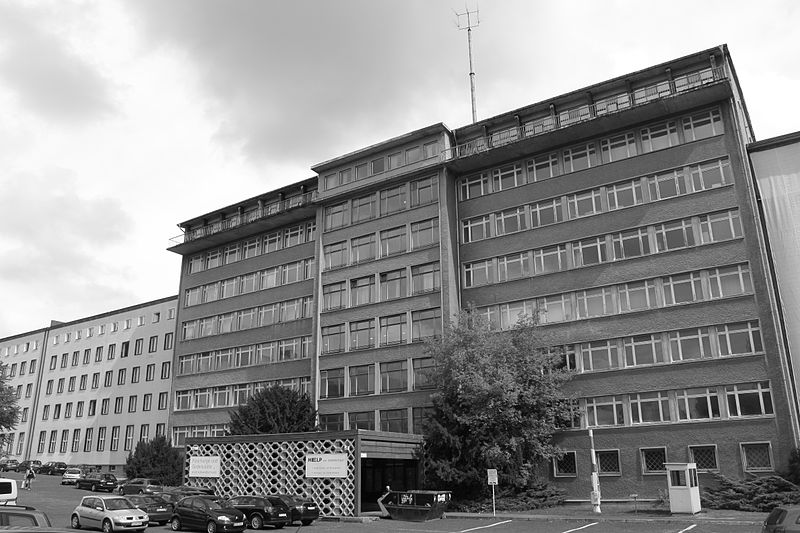
The Stasi Headquarters, Lichtenberg, Berlin
I am sitting in the cafeterior of the Stasi museum, located fittingly in the old headquarters of the Stasi in Lichtenberg, Berlin. The walls of the room are placid yellow - faded like a cigarette butt that's been left in a sunlit ashtray. The chairs are brown, like the floor and the windows are too high to bring any natural light into the room, leaving visitors to be doused instead in an dull artificial glow. Each table has a very small cactus on it, no doubt to bring the smallest amount of colour into the otherwise desolate room. 

On the far wall there is a display behind glass of full alcohol bottles with their companion glasses - the labels are all strange to me and reek of a time when sourcing of goods was primarily done from "socialist allies". No Bacardi for them. The building, like the room, could never be accused of resembling anything of the glamour, colour, vibrancy and variety of modern life in Berlin. The cacti's failure in the middle of my table is testament to that. 

The building has an air of James Bond about it, coming from a time when the means of oppression were almost pantomime in their presentation: bare walls, bad furniture, no decoration and no variety. Additional to the decor of the pantomime palace of evil, is the resident pantomime villain presented in a exhibition upstairs of the office he used to frequent. I am talking of Erich Mielke, who was head of the Stasi from 1957 to 1989. Anna Funder, author of Stasiland, wrote of Mielke: "It is said psychopaths, people utterly untroubled by conscience, make supremely good generals and politicians, and perhaps he was one." He was above all things, a committed Stalinist communist who believed that control of every human impulse was necessary and control over society made possible by knowing everything about everyone at all times. 

His rooms do not in themselves display anything all that sensationally interesting. Everything has been emptied - all locks unlocked and files un-filed. However, there is a safe cabinet - a locked metal cabinet that sits in the corner of the room. It is a dark, grey green cabinet with metallic flecks. The door now stands ajar and inside are empty shelves stained with lost piles of books, files, information and papers - secrets. The cabinet now sits empty in an empty room that without the placard on the wall would mean nothing to no one. But at one time, not so long ago - my lifetime ago - that room and that cabinet held the freedom or imprisonment of thousands. The key to that cabinet would have been one of the most safely guarded items in the DDR. It is said that Mielke held secrets in that cabinet that would have enabled him to dispose of even Honecker (Head of State from 1976-1989) if need be. Yet now it stands, empty and alone in an unlocked room with no purpose. 

But what of our pantomime villain's handmaidens - those diligent comrades who gave the information that was used to lock up their fellow citizens in the hundreds and thousands? There is a great video upstairs talking about the recruitment of informants - one of the most talked about and debated aspects of Stasi oppression. It talked of a shift from forced recruitment (familial threats, imprisonment or hushed up convictions) to "politically or ideologically committed informants". 90% of informants by the end, did it because they wanted to, or they saw the benefits for their career, income or housing. Figures vary, but some suggest that there were up to 190,000 informants (IMs) and 90,000 who worked directly for the Stasi; making it one of the biggest state security apparatus' in history. 

It makes me wonder though, about the modern equivalent. The Snowden leaks make it clear that the capabilities of our own security apparatus' in western countries would shock and awe the Stasi. Yet there is no building with blank walls, bad furniture and drab colour schemes to visit; there is no pantomime palace of evil, or pantomime villain sitting at the centre of all to direct blame or fury at. The reality of modern surveillance is that it really is everywhere, and we are all informants. 

We live in an age when ideology is completely unnecessary now, a result of the failures of 20th century political systems. We have become disillusioned with grand visions of society - but have inadvertently all become informants to keep up the regime of market fundamentalism. There is a cartoon  upstairs of a boney skeletal hand coming out of a large coat and trying to grab the hand of an honest socialist. The hand is named CIA. It was a poster designed to encourage DDR citizens to be aware of the corrupting influence of the US secret services. Today though, there is no covert meeting planned and executed on park benches by men wearing trilbies and raincoats, there is no need for that. The internet history of every citizen in the western world, and to a degree globally, is enough. There is no cabinet of locked away secrets to bring down the head of state if necessary, just a direct tap to a cellphone, or tablet. Was there perhaps comfort back then in the fact that evidence could be found, touched or destroyed? 

People say that after Erich Mielke was arrested and imprisoned for the murders at the wall, he was supplied with a red telephone, the like of which he had used during his time in office. The telephone was not connected to the outside world, though he would frequently be overheard shouting down the phone orders to no one and asking for his dog to be brought to him immediately. His dog was already long dead at this point. 

It seems to me, that though there is always change, it never turns out quite as you expect.   


Sunday, 31 May 2015

Beelitz Heilstätten: Nature's Revenge

Main Building Interior. Maddie Eckert, Beelitz Heilstätten 2015
Of all the abandoned buildings dotted around Berlin none receives quite as much attention, both digitally and in conversation, as Beelitz Heilstätten on the outskirts of Berlin. That is no doubt, because this old decrepit, falling down hospital appeals to that rather morbid side to us - here is a place where many people have died.

In fact, people were dying there for nearly 100 years from 1898 till 1994, when the hospital hosted its last patients. This rather morbid, yet understandable, fascination is also ignited further by the knowledge that Hitler and Hoenecker were once treated here - in 1916 and 1990 respectively. The ghosts of these past dictators haunt visitors with their long since silent footsteps through the leafy grounds of this once haven of healthcare.

Maddie Eckert, 2015, Beelitz Heistätten
However, travelling there on a sunny day in May as I did but last week, it was not a haunted horror house that I encountered, but in fact a place so brimming with life that it seems to be bursting out from every corner of the ruined buildings.

Beelitz started life as a sanatorium for those suffering from lung infections during a time when sooty air was about as good as it got in the city centre for many working class people. It was a military hospital during WW1, hosting patients including a rather insignificant corporal by the name of Adolf Hilter - recuperating from a bomb blast wound he sustained at the Somme.

After WW2 the hospital was turned into the largest military hospital in the Soviet Union outside of Moscow. It remained the prized military hospital in GDR Germany until its last patients were turfed into the milieu of the post unification German healthcare system in 1994. Since then it has been left to rot.

Women's Sanatorium. Maddie Eckert, 2015, Beelitz Heilstätten
Investors, as they always seem to, quickly bought the complex - its beautiful wood surroundings and proximity to the capital no doubt adding to its attractions. However, after going bust in 2001 the old hospital never had that corporate revamp that seemed so inevitable back in '94.

So 20 years on, in 2015, it seems that nature has taken the baton of change for this ruin and is shaping the buildings with a uniqueness that only nature can offer. Broken glass and graffiti plastered all over the walls pay homage to vandals of days gone by - but nature is the real victor in the descent of this building into rubble.

Trees, rooted in piles of collapsed stone and concrete, have somehow found enough organic matter to grow out of the middle of roofless rooms. They twist and jerk suddenly out of windows gathering height to reach more sunbathed stretches. The flat roof of the largest building at the back of the complex has now become a forest with a soil depth of up to a metre and countless varieties of trees and plants.
Nature's Revenge. Maddie Eckert, Beelitz Heilstätten, 2015
These are not the manicured additions to nature so often associated with human gardens, but natural reclamation of the space by the green goddess herself. Using her faithful comrades: wind, water, air and sun, nature has grown a forest on a building broken by the annals of human history.

Beelitz has a web presence describing the buildings as echoey glimpses of a rather haunted and dark past - but for me that is not enough. We must also pay homage here to the rebirth of an ecosystem sitting comfortably within 20 years atop these human configured foundations. What, then, is a faded memory for humans, is just a new beginning for an old master of this very old planet.

Friday, 15 May 2015

The Olympic Stadium: the Folly of a Few

On a wet and windy day at the cusp of the long darkness of Berlin’s winter, I went to Berlin’s Olympiastadion (Olympic Stadium). I went here because it’s on the other side of the city from my home. I went because I needed an escape from the day-to-day humdrum that was also conveniently well within the realms of Berlin’s AB zone! But I also went because I wanted to inspect the folly of men. The folly of the few who were able to manipulate the many and weave a path that destroyed so much. I went there because I wanted to feel the darkness of what could happen if humanity is driven from the sensible to the insane. I went to inspect the ruin of a fallen regime that drove fear and hate into the hearts of millions.
Leslie Hossack, East Gate, 1936 Berlin Olympic Stadium
But instead, standing at the entrance, as if at the helm of a huge ship, I felt awe.
The stadium is huge: a magnificent oval that stretches out before the eyes and engulfs the plane of vision like the Colosseum in Rome. The style is one of classical brutalism: a convergence of Greco-Doric architecture and concrete. It is a benchmark of the Nazi regime, which paid homage to Imperial Rome whist creating a cultural and spiritual rebirth of an ancient German civilisation. The Doric shaped concrete is an emblem of this style, combining ancient-type pillars with brutalist materials to create a terrifying vista of bleak grandeur.
The original stadium was built by Nazi architects for the 1936 Berlin Olympics, and was meant to symbolise the power and strength of the 1,000 year Third Reich - just 3 years in. It was built to promote national pride and instil a sense of grandeur to Berlin after years of economic struggle.
Information boards line the stadium containing huge swathes of facts concerning the building’s history, the opening ceremony, the construction of the stadium, the watch tower, the statues’ mythical inspiration and the great feats of engineering that went into the stadium's erection in the 1930s. But, perhaps surprisingly, there is nothing on those boards about the controversial regime that built it. 
There is nothing there that would tell someone who didn’t already know that this was built as a monument to a terrifying ideology of fear and hatred; a part from perhaps the road leading away from the stadium, appropriately named Jesse Owens Allee – as if the 3 gold medal winning African American runner is still running from Fascism nearly a century later. This stadium, in all its grandeur, is the physical manifestation of how wrong humanity can get it; but one could forget that in the peace and quiet of the awe-inspiring interior. Ultimately, for me the place embodies the tragic contradiction of men – that though they can be great and create wondrous things, they can also synonymously commit insurmountable destruction and pain.
On the other hand, the Olympic Stadium’s fraught past also contains a great moment for Germans, who sought to participate and watch the games at a time when national pride was difficult and economic conditions were rough for the majority of people. Since then, the stadium has also seen many international games including the FIFA Football World Cup in 1974: these occasions are clearly why it has been kept in such good shape over the years.
The stadium has been given a new roof to protect it from the elements: from rain and wind, and sun during the summer. In 2002, whilst completing a huge extension of the seating area, an unexploded WWII bomb was found underneath a section of existing seating; a weapon of destruction to remind us that the stadium was not always so glossy.
As I sat gazing at the bright green grass of the pitch kept lush even on a cold day in October and the glittering rails leading to the shiny seats, I wondered, who made that decision? Who made the decision to remember the stadium as a memorial to a great sporting past rather than a monument to a fascist regime?
The stadium for me gives us a small glimpse of a the conflict in Berlin’s history: on the one hand monumental feats of architecture has been achieved here that pay homage to ingenuity and strength; but one the other hand these feats can be dragged down in an instant into the mire of confused loathing for a time when a brutal ideology became normal and diversity was eradicated. Perhaps though, the most important aspect of this conflict is how present Berlin has chosen to remember the stadium – as a symbol of national sporting pride. Perhaps the alternative history should be left to rest at last.

Musings on Monuments or Monumental Musings

Monument is a funny word. It is so often used to describe fancy palaces, statues, arches and random pointed pillars that ascend out of the ground and have names etched on them. The word conjures stand-alone pieces of architecture that perform no function whatsoever but to remind people of something that happened long ago that no one quite remembers. But for me, monuments are all around us; everywhere we turn, reminding us constantly of days gone by.
A monument is anything that contains at least some history of the society it was created in. A monument is an object or building that makes one’s imagination run wild with the “I wonder who lived here” or the “I wonder what kinds of things happened here”. A monument is a piece of the past preserved in the present that emulates mystery as well as meaning to those with an active imagination.
I have just celebrated my 2nd Berlin Birthday and to mark this rather wonderful occasion I have decided to do what no other expat has ever decided to do – and start a blog about Berlin ;): more specifically, a blog about the history contained in the nooks and crannies and crevices of this great city. In the stadiums, the derelict houses, the old Stasi prisons, the airports and streets that drip with history for those who search for it.

So if you love the idea of buildings oozing out past encounters, of streets revealing their deepest secrets and parks innocently lying atop the ruins of a past city centre then read on! This blog will be as much homage to a great city, as a fact checked exploration of days gone by.